What Is IRATA Rope Access and Why Does It Matter Who You Hire?
If you have been researching rope access services and repeatedly come across the acronym IRATA, you may be wondering what it means and whether it matters. The simple answer is yes, it matters significantly when choosing a rope access contractor in the UK. This article explains what IRATA rope access is, how it differs from unregulated work at height and why choosing the right contractor is one of the most important decisions you will make.
What Does IRATA Stand For?
IRATA stands for the Industrial Rope Access Trade Association. North Sea oil and gas companies founded it in the UK in 1987 to create a safer and standardised rope‑based system for working at height. They originally developed the method for offshore inspection and maintenance where scaffolding was not practical.
Today, IRATA International serves as the globally recognised authority for industrial rope access. Members operate in more than 60 countries and represent thousands of technicians and companies. IRATA maintains the International Code of Practice (ICOP), which sets out how teams must plan, supervise and carry out rope access work.
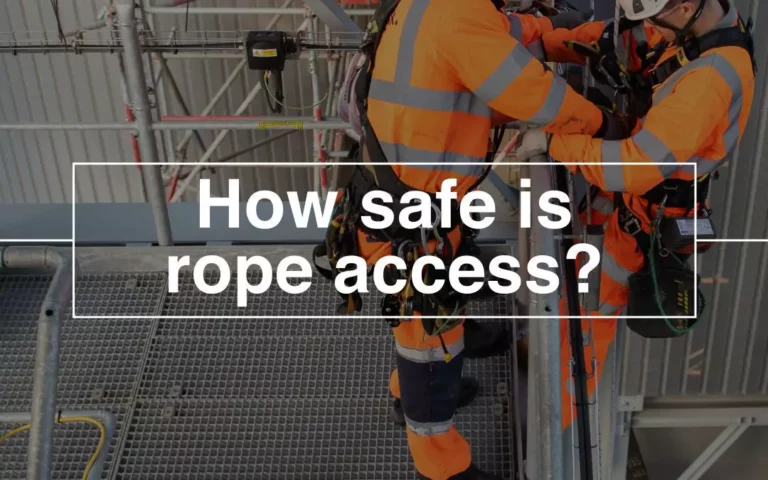
IRATA consistently records some of the lowest accident rates in the work at height sector. Its strict training, supervision and equipment standards, supported by independent audits, drive this strong safety performance.
How the IRATA Certification System Works
IRATA operates a three‑level certification structure. Each level defines the role and capability of the technician.
- Level 1 Technician: Can perform rope access tasks under direct supervision. Trained to ascend, descend and traverse ropes and complete basic rescues.
- Level 2 Technician: Can work with reduced supervision. Competent in rigging and de‑rigging systems and carrying out more complex rescues. Often acts as a working supervisor.
- Level 3 Supervisor: Responsible for the full planning and supervision of rope access operations. Authorised to sign off systems, complete risk assessments and manage all rescue arrangements. An IRATA Level 3 must be present on every IRATA‑compliant rope access worksite.
To achieve any level, technicians must complete training with an IRATA‑approved provider, pass practical and theoretical assessment by an independent IRATA assessor and revalidate every three years. Certification cannot be self‑declared or purchased.
IRATA member companies must also undergo regular audits covering safety management, equipment inspection, contractor competence and incident reporting. Membership is an ongoing commitment rather than a simple registration.
What IRATA Rope Access Is Used For
Rope access is used anywhere that work at height or in difficult locations is required. Typical applications include:
- Inspection, testing and non‑destructive testing of bridges, chimneys, towers and offshore structures
- Surface preparation, concrete repair and protective coatings on buildings and infrastructure
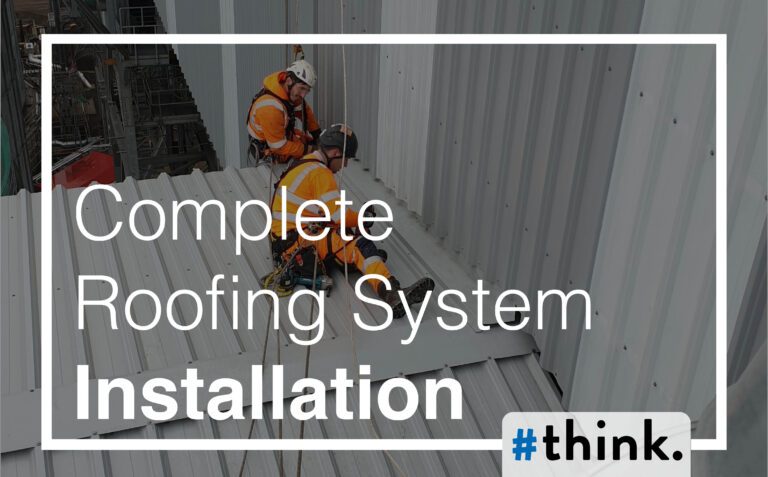
- Cladding installation, façade maintenance and remedial works
- Industrial cleaning and vacuumation of tanks, silos and process equipment
- Confined space entry for inspection and maintenance
- Bird control and pest management at height
- Installation of safety netting and temporary fall protection systems
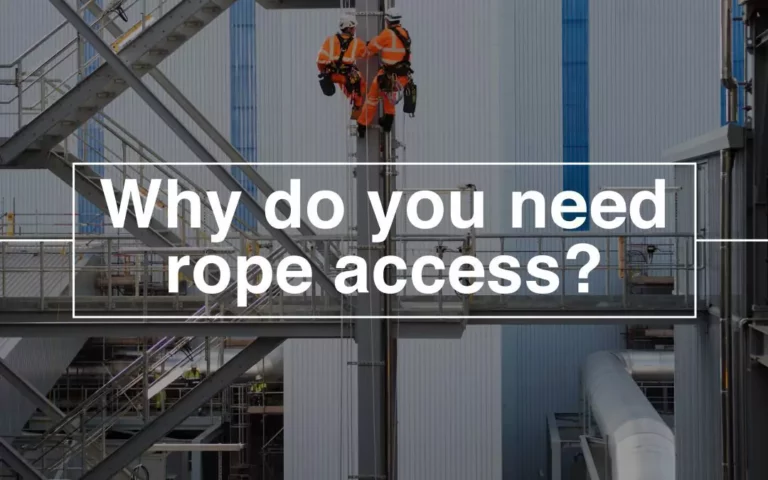
In all cases, rope access offers a faster and less disruptive alternative to scaffolding or mobile elevated work platforms. It allows technicians to reach areas that are otherwise inaccessible, and it does so with a proven safety record.
Why It Matters Who You Hire
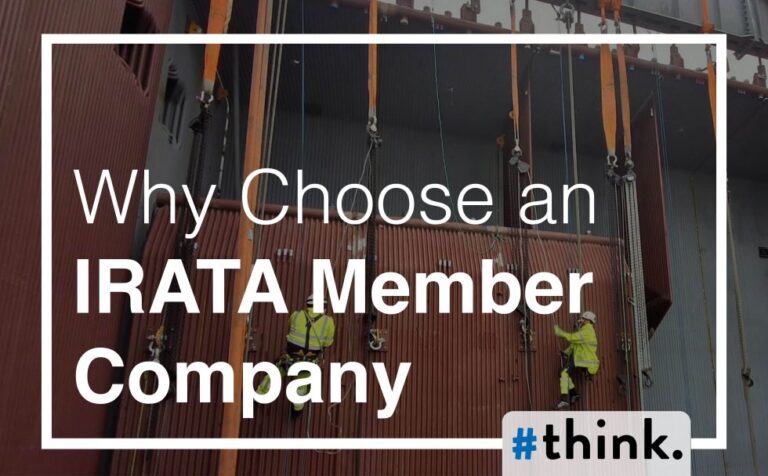
Not all companies advertising rope access services operate under IRATA standards. Some offer rope work without IRATA membership, which means:
- Their training may be informal or unaccredited
- Their equipment may not meet the inspection standards required under ICOP
- No independent body oversees or audits their safety processes
This is important for several reasons.
Compliance: Many regulated sectors require contractors to meet recognised industry standards. IRATA membership provides this assurance.
Legal responsibility: Under the Work at Height Regulations 2005, you must ensure work is planned, supervised and carried out by competent people. Using an unaccredited contractor does not remove your liability.
Insurance: Insurers may review contractor competence after an incident. Using an unaccredited provider may increase your exposure.
Safety: IRATA statistics clearly demonstrate the reduced incident rates associated with its system of work. Working outside that system increases risk.
What to Check Before Appointing a Rope Access Contractor in the UK
Before committing to a contractor, confirm the following:
- They are listed as a current IRATA member company on the official IRATA directory
- Their technicians hold valid IRATA certificates for the required level
- They maintain ISO 9001, ISO 14001 and ISO 45001 certifications
- They hold Constructionline, CHAS or equivalent accreditation
- They will provide project‑specific RAMS before work begins
A trustworthy contractor will supply these details without hesitation.
Think Access Group: IRATA Rope Access Specialists
Think Access Group is a fully accredited IRATA member company, a trusted rope access contractor operating across the UK. All projects are supervised by an IRATA Level 3 Supervisor. Our teams deliver rope access solutions across construction, energy, oil and gas, commercial facilities and major infrastructure.
We hold ISO 9001, ISO 14001 and ISO 45001 certifications along with Constructionline Gold and CHAS accreditation. Every project is supported by complete RAMS documentation, daily task sheets and digital client sign‑off through our Get Konnected platform.
If you need a safe and reliable rope access contractor, our team is ready to help.
Sources & Further Reading
The following sources informed this article:
- IRATA International — International Code of Practice for Industrial Rope Access (ICOP)
- IRATA International — Work & Safety Analysis Reports
- Health and Safety Executive (HSE) — Work at Height Regulations 2005.
- HSE — A Guide to Managing Work at Height.
- Constructionline — Gold Membership Standards.
- CHAS — Contractors Health and Safety Assessment Scheme
- 10 Reasons to use an IRATA Member Company
Get a free quote
Tell us about your site and we’ll come back to you, usually within one working day. Prefer to talk? Call us free on 0800 433 7859