Four More ECITB Level 3 Steel Erection Qualifications. Here’s Why That Matters.
A few months back we wrote about why NVQ-qualified rope access steel erectors make a genuine difference on structural projects. If you haven’t read it, it’s worth a few minutes of your time.
The short version: qualifications in this discipline aren’t just paperwork. They’re proof that the people working on your structure understand what they’re doing at a level that protects your project, your programme and the people on site.
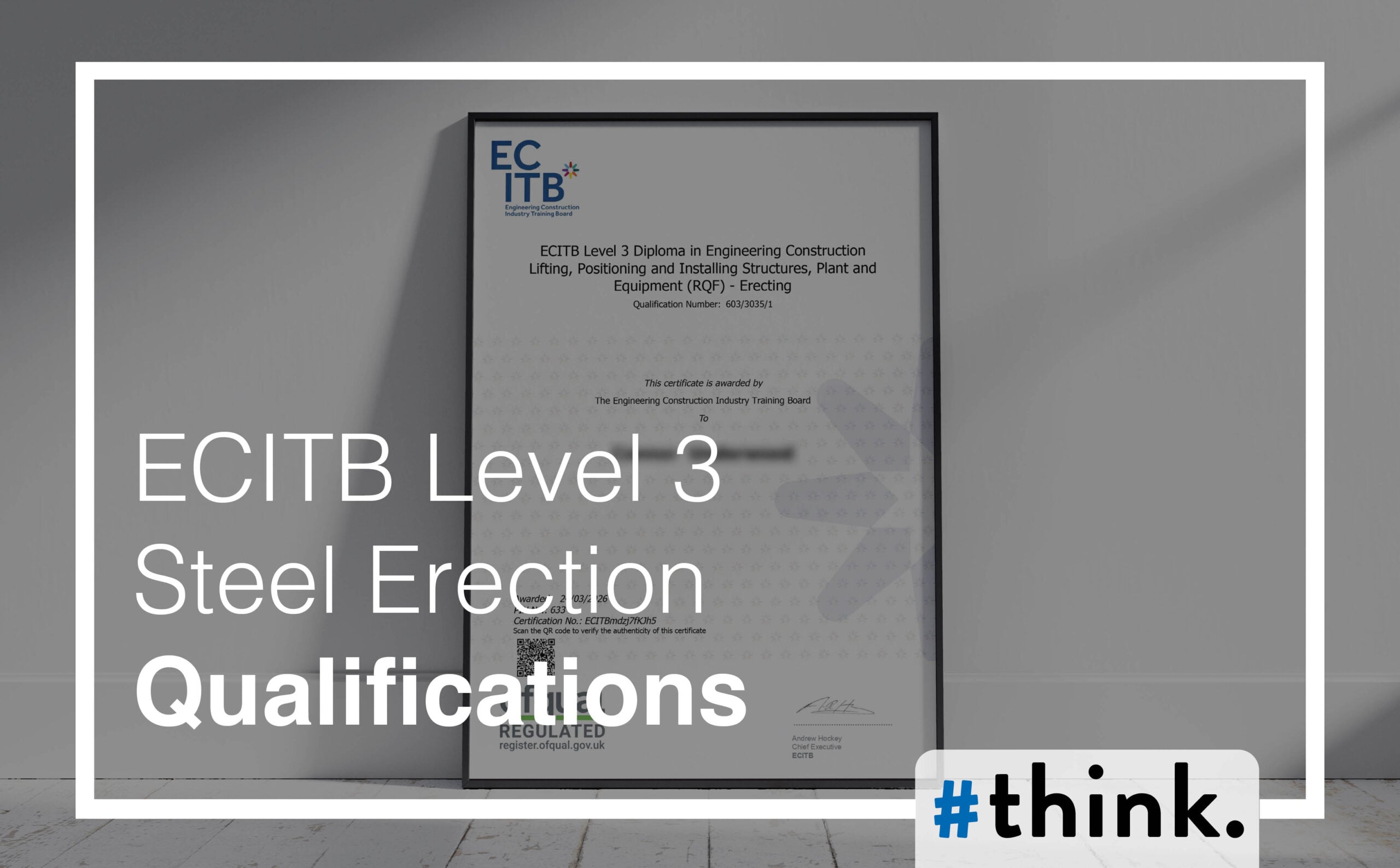
So we’re pleased to share that four members of the Think Access team have now achieved their ECITB Level 3 Diploma in Engineering Construction Lifting, Positioning and Installing Structures, Plant and Equipment (Erecting Pathway). That’s the full vocational qualification for structural steelwork installation, and it’s not a straightforward one to get through.
What the Qualification Actually Involves
Operatives must demonstrate they can work safely, effectively, ethically and sustainably while managing risk and hazards throughout their work. This is the foundation unit of the qualification and underpins all practical activity on site.
Also covered under the qualification structure: interpreting and following maintenance documentation and procedures, and preparing and reinstating the work area (Unit LPI02).
Operatives must be able to determine the technical and resource requirements for a job (LPI03) — understanding what equipment, personnel and methods are needed before work begins.
They must also demonstrate competence in preparing loads for moving, lifting and positioning (LPI04), a core practical skill that directly relates to rope access steel erection work.
Three units cover the core erection process: moving loads (LPI05), positioning and installing construction elements and assemblies (LPI06), and checking that installed elements meet specification (LPI08).
LPI08 is particularly important — it confirms the operative can verify their own work against technical requirements, not just carry out the installation itself.
The qualification also covers dismantling construction elements or assemblies for movement (LPI07) — recognising that site work often requires safe removal as well as installation.
The final unit, undertaking complex movement of loads (LPI09), is the most advanced practical element — it tests the operative’s ability to manage challenging lifting and positioning scenarios that go beyond standard operations.
All 9 units are assessed in the field by an ECITB approved centre over a typical period of 36 months.
The ECITB Level 3 Diploma is a rigorous, practically assessed vocational qualification. It tests real competence across the full scope of structural steel erection: understanding load paths and connection details, sequencing erection correctly, working safely within the tolerances that structural integrity depends on.
It’s designed specifically for the engineering construction sector, which means the standards it sets reflect the conditions our teams actually work in. Industrial facilities, complex steel frames, projects where getting the erection sequence right matters from day one.
Each of the four team members worked through this alongside their normal project commitments. Assessments on top of live site work, study around a full schedule. That takes a certain kind of dedication and each of them has earned the result.
What It Means for Clients
This is where it becomes more than an internal milestone.
When you’re appointing a rope access contractor for structural steel work, competency documentation is one of the first things that gets scrutinised. Principal contractors, project managers and HSE all want to see that the people going up on that structure have verifiable, recognised qualifications. The ECITB Level 3 Diploma answers that question clearly.
In practice, having more qualified steel erectors in the team means a few things:
Pre-construction moves faster. Competency queries get resolved quickly because the evidence is there. Method statements and RAMS don’t get held up waiting for qualification records to be chased down.
Execution on site is tighter. These aren’t operatives following a checklist. They understand the why behind the sequence, which matters when conditions change or when a connection detail needs interpreting in the field.
Fewer people, less coordination. When your rope access team can also carry out the steel erection work once they’re in position, you’re not managing two separate specialist crews. That reduces interfaces, keeps programmes on track and typically brings the overall cost down.
Growing the Team’s Capability
At Think Access, this kind of investment in qualifications is deliberate. Rope access done well isn’t just about getting people to difficult places. It’s about what those people can do once they’re there.
Adding four more ECITB Level 3 qualified steel erectors to the team strengthens what we can offer on structural projects, and it reflects the standard we hold ourselves to across the board.
Congratulations to the four of them. It’s a proper achievement and the projects they work on will be better for it.