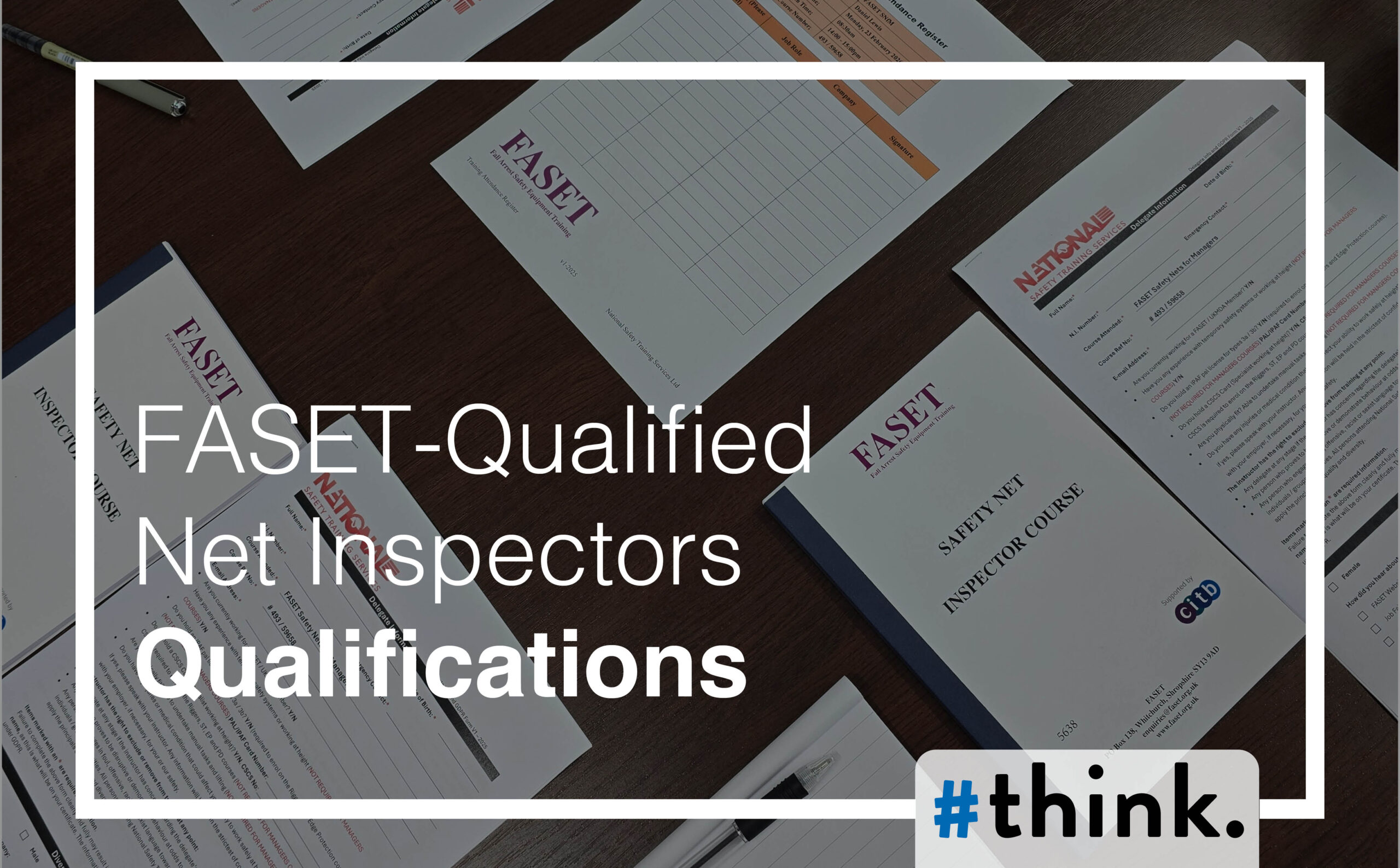
Three Members of the Think Access Team Have Completed the FASET Safety Net Manager’s Course
Safety netting doesn’t get talked about as much as some other disciplines. It’s not the most visible part of a construction project, and when it’s done right, nobody notices it at all. That’s rather the point. But the people installing and inspecting those nets are carrying a serious responsibility, and the qualification that sits behind that work matters more than most clients ever see.
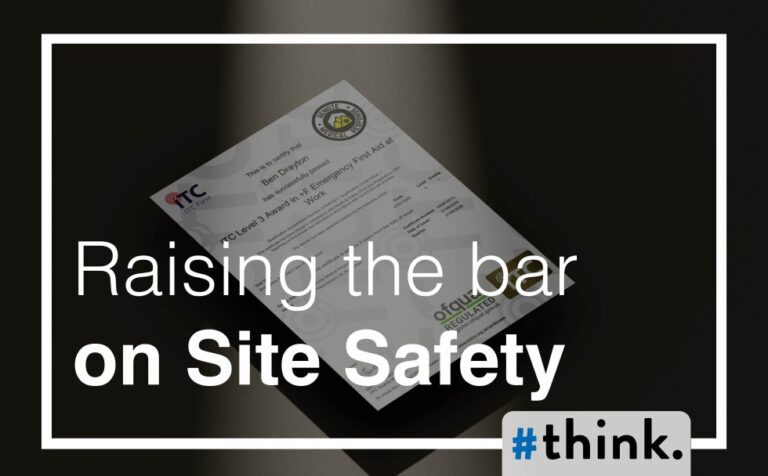
Three members of the Think Access team have just completed the FASET Safety Net Manager’s course, covering the requirements of BS EN 1263-1, BS EN 1263-2 and BS 8411 alongside industry best practice. We’re proud of all three of them, and it’s worth taking a few minutes to explain why this particular qualification carries real weight.
What FASET actually is
FASET is the trade association for safety net rigging and temporary edge protection installation. It sets the standards, provides the training framework and accredits the companies and individuals working in this space. It’s not a membership you buy; the accreditation is earned, and the qualifications it awards are built around the requirements of BS EN 1263-1, BS EN 1263-2 and BS 8411, the standards that govern the design, performance and use of safety nets in construction.
For more on FASET’s work and standards, their official guidance is available at www.faset.org.uk. BS 8411 and the BS EN 1263 series are published by the British Standards Institution at www.bsigroup.com.
What a net inspector checks
The Safety Net Manager’s course specifically covers the competency required to inspect installed safety netting systems and confirm they meet the standard before work above them proceeds. That’s not a rubber stamp exercise. Inspectors are checking net condition, anchor integrity, overlap, sag, the correct installation of edge protection borders and whether the system as a whole will actually do what it’s supposed to do if someone falls into it.
Why the qualification is hard to get
It’s worth being straight about this. The FASET Safety Net Manager’s course isn’t a day course with a multiple choice test at the end. Candidates need to demonstrate a genuine understanding of safety net systems: how they’re rigged, what the failure modes look like, what correct installation actually means in practice and how to identify when something isn’t right.
The Work at Height Regulations 2005 (available at www.legislation.gov.uk) require that anyone involved in planning or supervising work at height is competent to do so. Competence in this context means a combination of training, knowledge and experience, and the FASET Safety Net Manager’s course is one of the recognised routes to demonstrating that competence, covering BS EN 1263-1, BS EN 1263-2 and BS 8411 in full.
Each of the three team members worked through their assessment while staying on top of their normal site commitments. It takes time, focus and a willingness to sit with the technical detail rather than skim over it. All three did exactly that.
What it changes on site
Here’s where it becomes practical rather than just a nice thing to announce.
When safety netting is installed as collective fall protection on a construction project, the nets have to be inspected before the work above them can proceed. That inspection needs to be carried out by someone who is competent to do it and can sign off the system as compliant with BS EN 1263-1, BS EN 1263-2 and BS 8411. Without that sign-off, the work stops.
It doesn’t end there. Under FASET guidelines, installed safety nets must be inspected by a competent person at least once every seven days for the duration of their installation. That’s a weekly obligation, not a one-off tick. The inspection checks that the system remains in the condition it was signed off in: no damage, no unauthorised interference, no change to the anchor points or net configuration. A record of each check has to be kept and available on site.
Having qualified Safety Net Managers within the Think Access team means that both the initial sign-off and the ongoing weekly inspection obligation can be fulfilled in-house. When we install netting, we can inspect it. There’s no waiting for a third-party inspector to be scheduled, no gaps in the programme while a sign-off is chased. The client gets a compliant, documented installation and the paperwork that principal contractors and HSE actually want to see.
It also means the inspection is being done by someone who was involved in rigging the system, who understands how it went in and can identify anything that needs attention before it becomes a problem. That’s a different quality of inspection to one carried out by someone coming to the system cold.
The wider picture
At Think Access, qualifications aren't something we pursue for the sake of looking good on a capability statement. The work we do puts people at height on complex sites, and the people doing that work need to be genuinely competent at every stage. Safety netting is a good example of why that matters.
Collective fall protection works because it's installed correctly and inspected properly. Cut corners on either of those and you haven't got fall protection; you've got a false sense of security, which is considerably more dangerous than having nothing at all.
Congratulations to all three. It's a proper piece of work and the projects they go on to work on will be safer for it.